In October 2026, Rust received a major update that overhauled its farming and survival mechanics. Players can now build facilities to care for their tamed cows and sheep. Moreover, these animals can be bred to improve their genetics and provide valuable resources such as milk and wool. You can also trade your livestock with vendors at the Ranch and Large Barn stables, making these animals an important part of the game's economy.

Looking to create your own gaming server?
Rust Server Hosting
In our ultimate Rust livestock guide, we’ll break down the specifics of this new gameplay feature and explain its core mechanics. We'll also share some useful tips to help you become a successful farmer in the post-apocalyptic world of Rust.
Where to Find Cows and Sheep in Rust
In Rust, cows and sheep typically spawn in groups ranging from 1 to 4 animals. You can find them roaming freely in Forest and Tundra biomes. They also tend to spawn near specific terrain types, such as Fields, Forests, Roadsides, Riversides, Lakesides, and Rails. Alternatively, you can buy them at Stables, Barns, and Ranches through the Livestock vendors.
Note that player-owned livestock and wild cows or sheep share the same in-game models, making them visually identical at a distance. However, you can tell them apart using a few key behaviors and mechanics:
- Interaction: When you look at other players’ livestock, you’ll see UI showing their stats and offering possible interactions.
- Location: While wild cows and sheep roam freely around the map, tamed livestock is typically found near troughs, inside fenced pens, or at player-built bases.
How to Capture and Bring Livestock Home in Rust
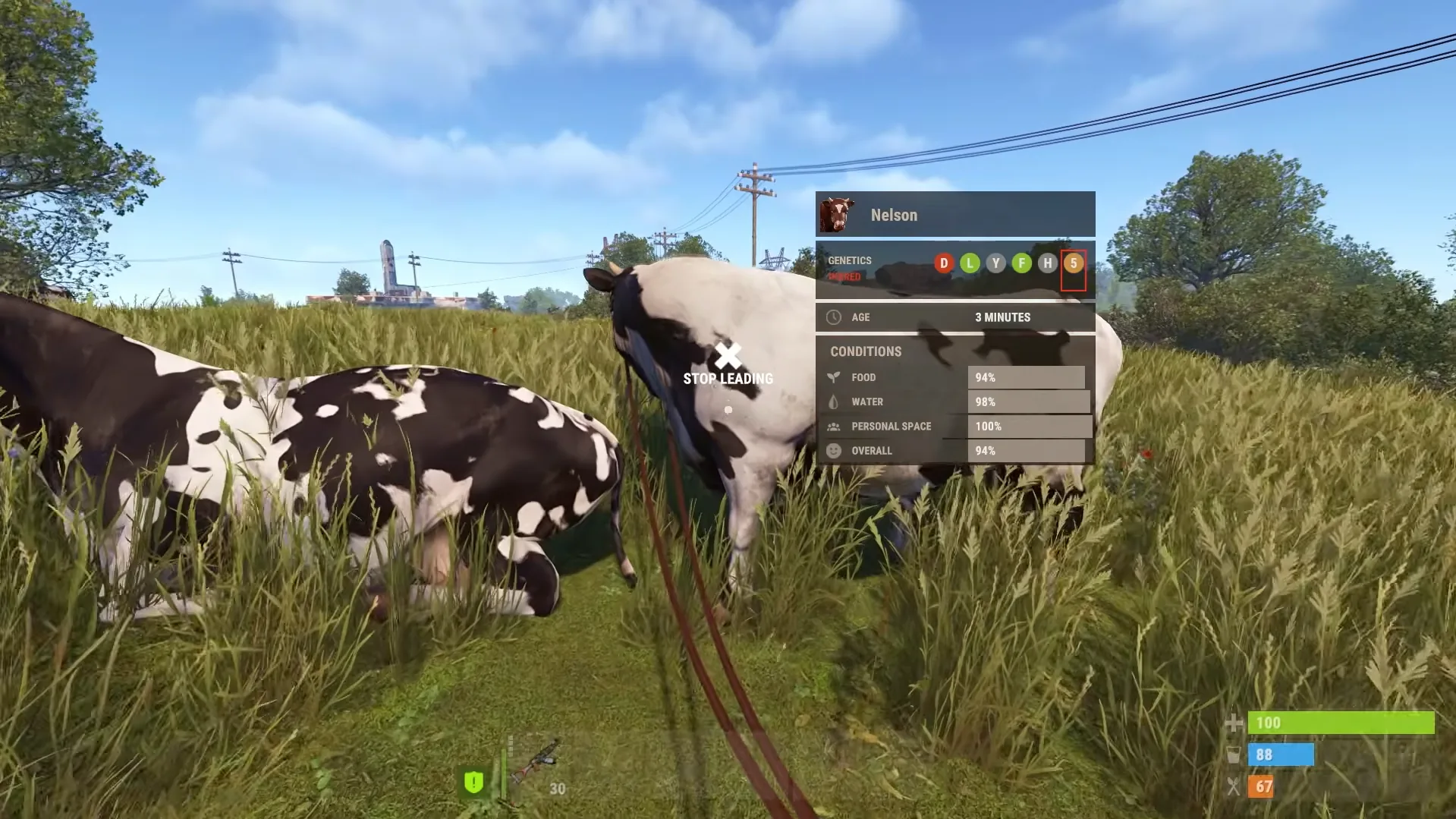
The Rust livestock update introduced two ways to obtain cows and sheep for breeding and resource production:
- Earning trust: Spend approximately 5 minutes within 20 meters of an animal without hurting it to earn its trust. Once it tolerates you, you will be able to lead it along with you.
- Buying: Buy a calf (300 scrap) or lamb (150 scrap) from the Livestock Vendor at the Ranch or Large Barn.
To bring an animal to your base, keep it within 7 meters throughout the journey to avoid breaking the lead. Alternatively, you can transport livestock more quickly using a vehicle equipped with a flatbed attachment.
How to Build a Livestock Pen in Rust
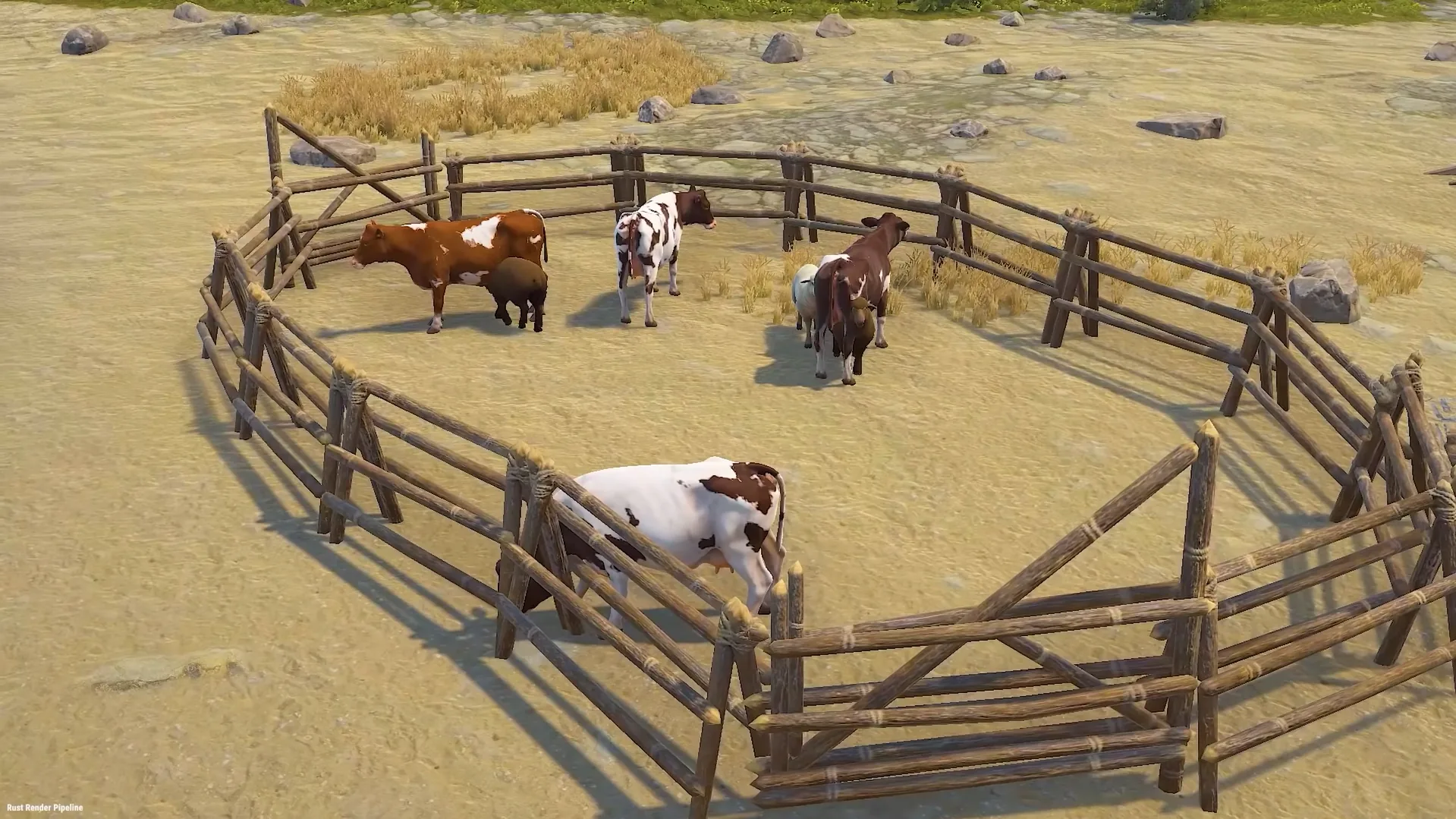
If you don't want your cows and sheep to run away, you need to keep them secure. Building a livestock pen will help protect your animals and provide them with food and water. First of all, you’ll need to craft parts for your construction:
- Animal Fence: Costs 250x Wood per unit. Use it to build the perimeter walls of your pen.
- Animal Fence Gate: Costs 500x Wood per unit. Place it within the fenced perimeter so you can walk in and out.
- Hitch & Trough: Costs 200x Wood. Place this inside the pen to supply your animals with food and water.
You should also carefully choose a location for your livestock pen. It’s a good idea to build it in an open area, where grass can grow for grazing. Also, you can place a pen near a river to keep your animals hydrated. Finally, ensure that the livestock pen is located close enough to your base so you can defend it and far away from roads to avoid unnecessary attention from raiders.
Livestock Needs in Rust
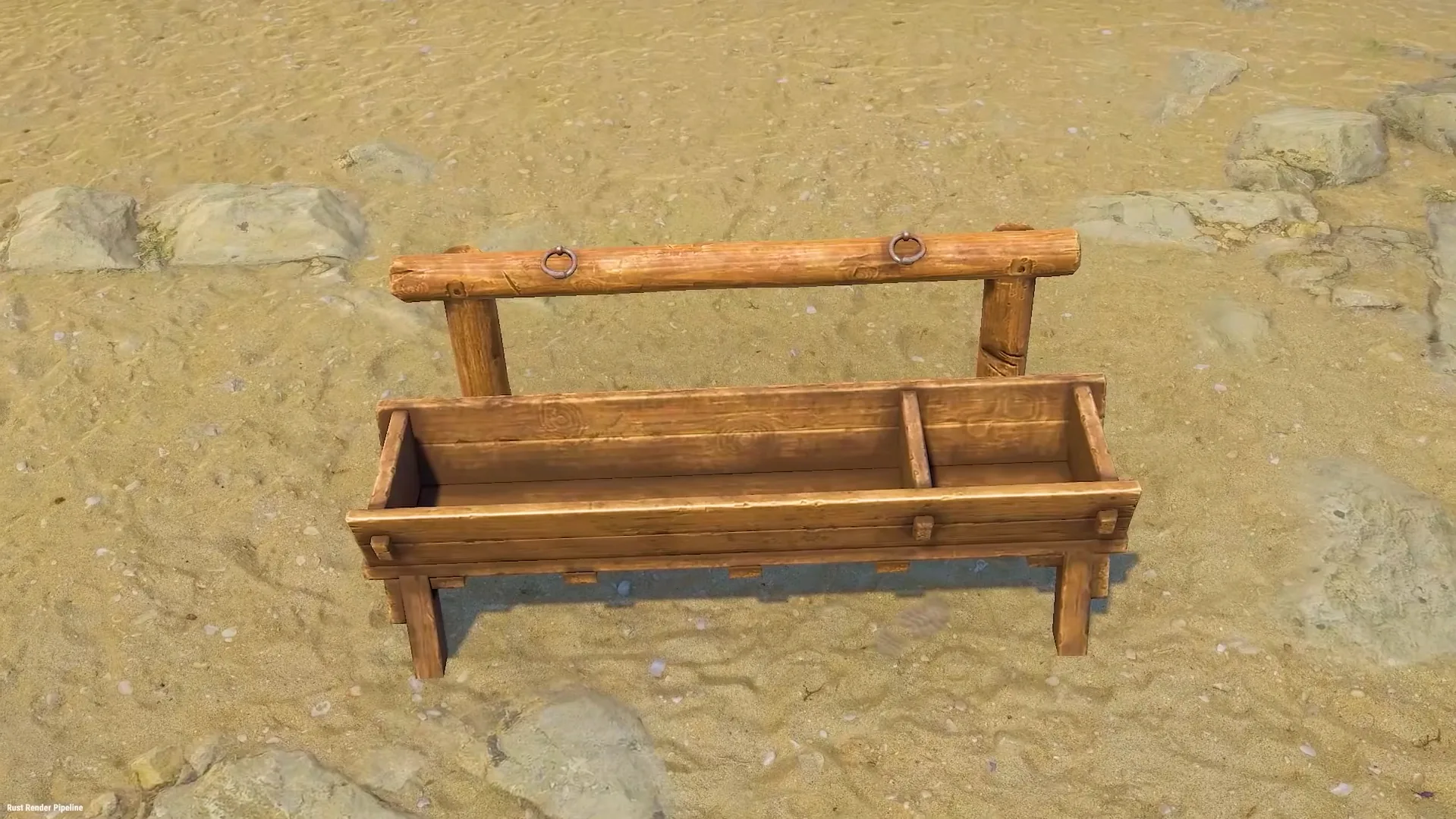
Your Rust sheep and cows have needs you must satisfy to keep them breeding and generating resources. There are three core needs that determine an animal’s overall condition. If any of these needs drop too low, it will negatively affect your animals:
- Food: Livestock can naturally graze on grass within roughly a 25-meter radius. If animals graze on the same area twice, it receives the “Grazed Bare” status for 30 minutes. To prevent your sheep and cows from starving, you can also place a Hitch & Trough and stock it with edible items like corn, pumpkins, potatoes, or other fruits and vegetables.
- Water: Your animals need a steady source of water to maintain their hydration level. You can maintain it naturally by building an animal pen near a river or by filling the water section of a Hitch & Trough.
- Space: Both sheep and cows have a population density of 2 animals per km². The recommended group size is up to 6 sheep and 4 cows. Note that overcrowding will affect breeding and resource production.
Also, livestock have a sleep cycle. The animals go to sleep around 8:30 PM and wake up around 7:00 AM.
How Breeding Works in Rust
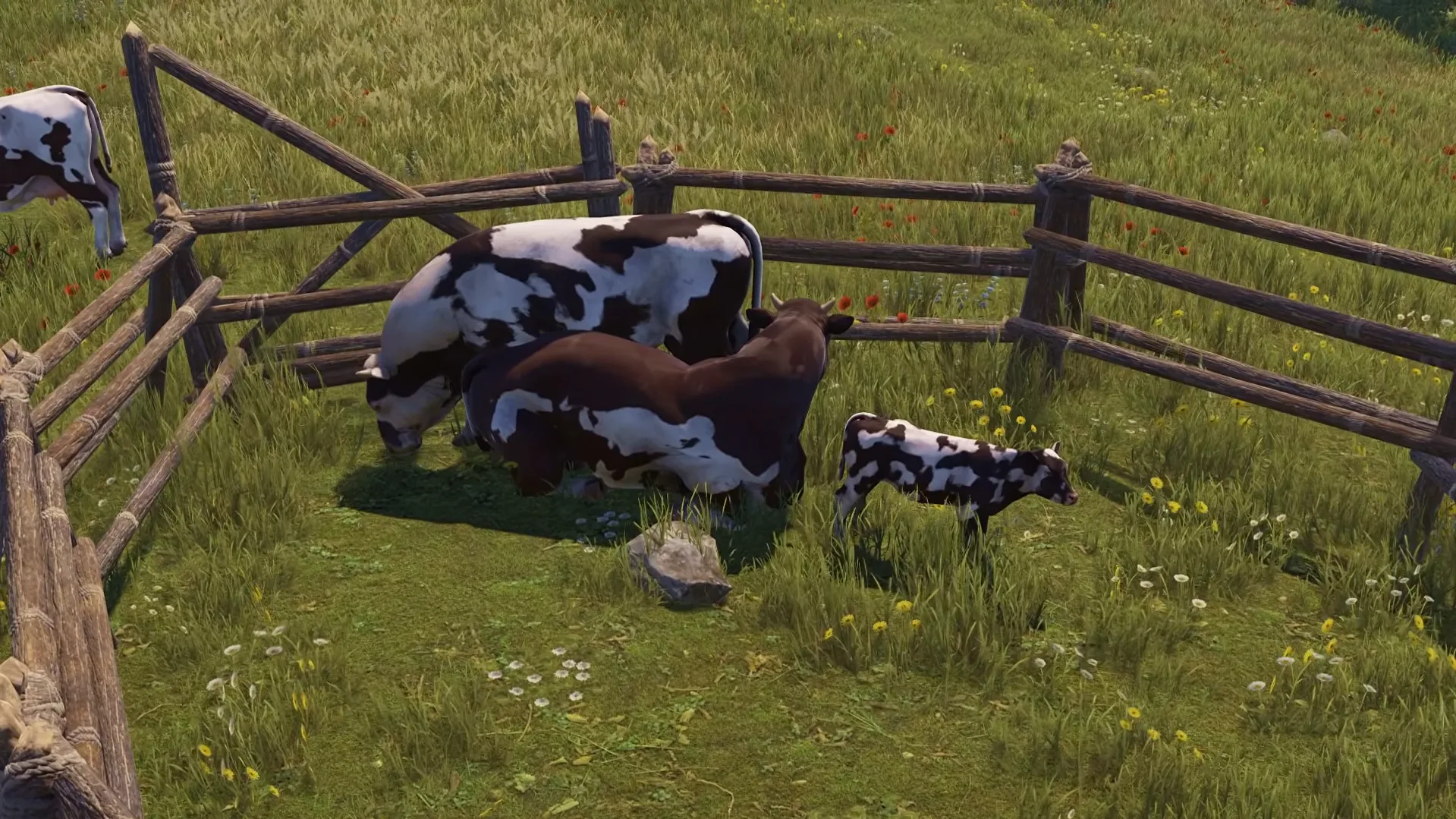
Animal breeding in Rust allows you to produce resources, improve your livestock's genetics, and trade animals with vendors. Regardless of whether you want to breed sheep or cows, you’ll need to meet some specific requirements first:
- Animals must be tamed: You can’t breed wild animals.
- Both animals must be adults and have different sexes: For example, you must place an adult cow near a bull.
- Overall animal condition must be high: For example, a cow's condition must be at least 60% to become pregnant.
- Cooldown time must pass: Bulls and rams have to wait nearly 10 minutes before they can breed again, while cows and ewes have a cooldown of one hour.
Place two animals in one pen and wait nearly 10 minutes before they give birth to a lamb or a calf. Note that the offspring's genes are defined by its parents, and you should consider genetics to create a better livestock line.
Rust Livestock Genetics Explained
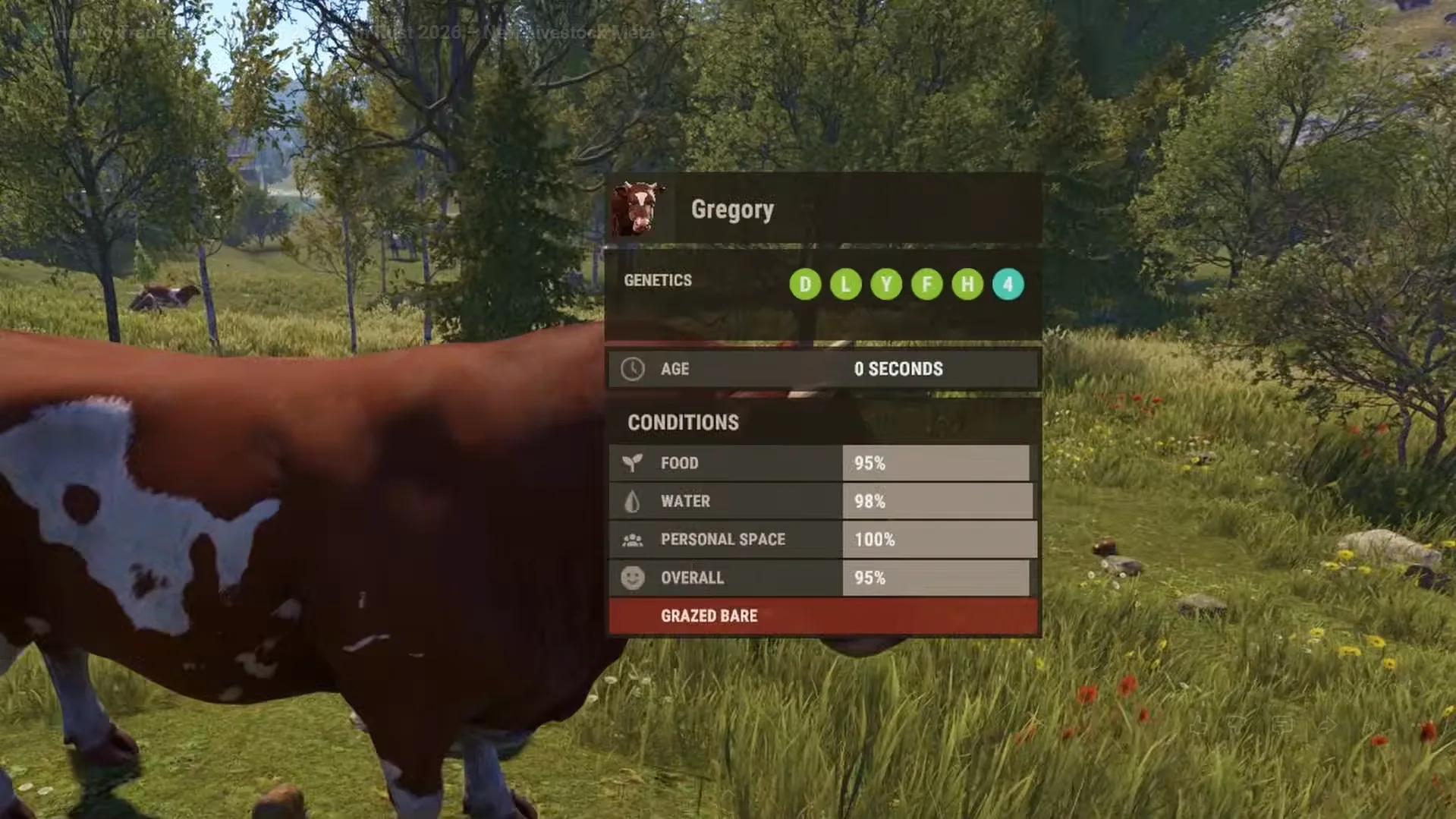
The Rust livestock breeding system heavily relies on genetics. You can check an animal's genes by targeting it and looking at the stats displayed underneath its name. They are divided into five types:
- D (Dung): Determines dung production speed.
- L (Longevity): Determines the animal’s lifespan.
- Y (Yield): Determines resource output.
- F (Fertility): Determines breeding cooldown.
- H (Hardiness): Determines whether an animal can survive in harsh conditions.
Each gene can have one of three grades: Green (Good), Gray (Average), or Red (Bad). For example, a cow with a Green Y gene can produce nearly 38 milk/hr, while one with a Red Y gene will bring you only 7 milk/hr. The game also features an inbreeding mechanic: breeding close relatives can result in offspring with weaker stats.
A newborn animal randomly inherits one copy of each gene from its mother and one from its father. To increase resource generation or to sell your livestock at higher prices, you should try to breed sheep or cows with all genes rated as “Good.” However, consider that it’s extremely difficult and time-consuming to reach this result.
What Cows Give You in Rust
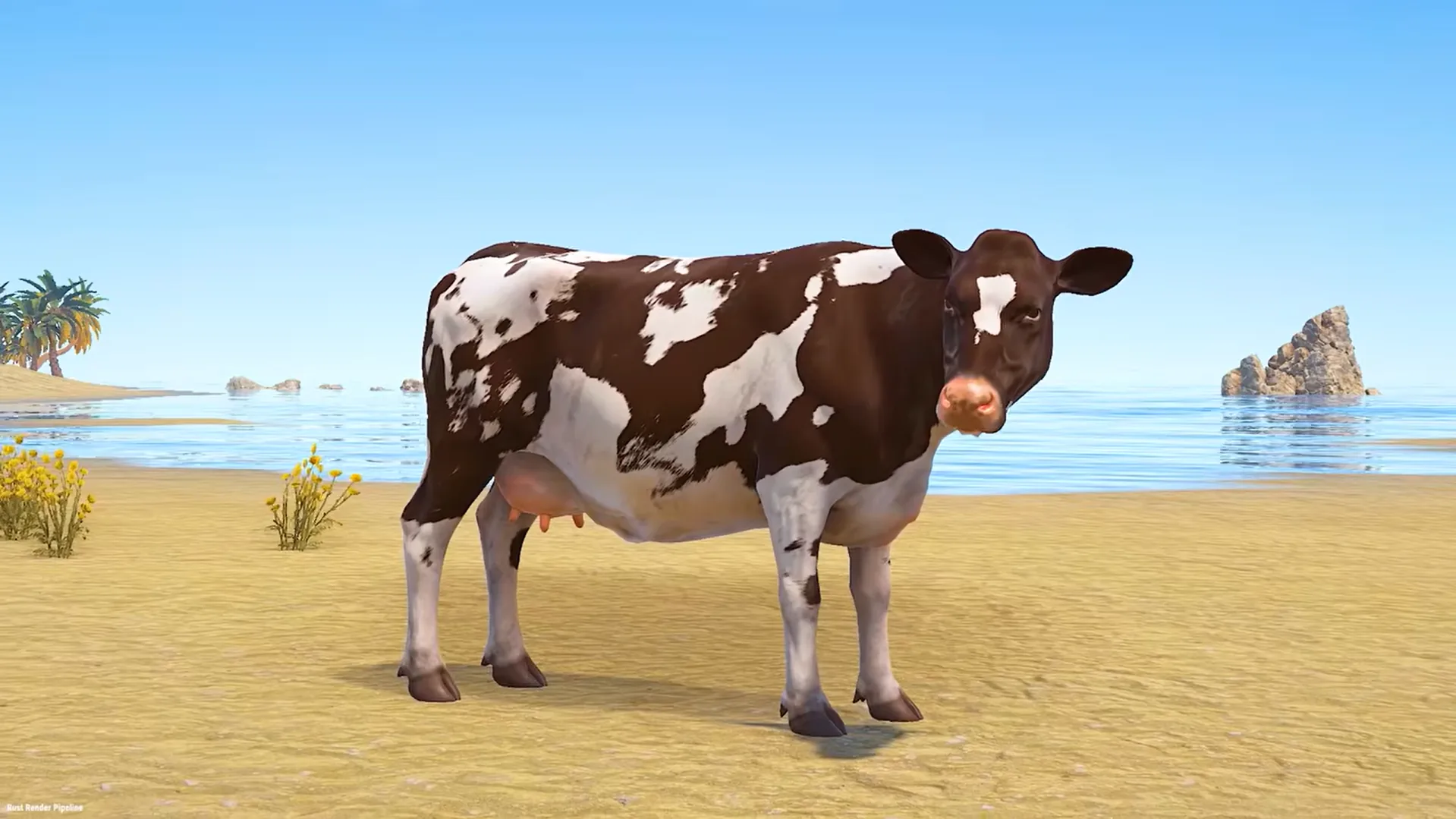
Keeping cows in Rust is a good idea since there are many ways you can use these animals. For example, you can breed cows to improve their genetics and eventually sell them for better rewards. Also, they produce a lot of useful resources, including:
- Milk: This is a new resource that you can get directly from a tamed adult cow. You can consume milk or skim it into Skimmed Milk and Cream.
- Dung: A non-starving cow produces dung, which may be used as an efficient fuel source or processed via a Biofuel Generator.
If you decide to butcher a cow, you'll get 25x raw beef, 100x leather, 100x bone fragments, 30x cloth, and 40x animal fat.
Skimmed Milk and Cream
Rust milk mechanics go far beyond simply milking cows. Once you've collected the milk, place it in a refrigerator for 4 hours. After this period, you can interact with the milk and select the Skim option. This separates it into two items:
- Skimmed Milk: It retains half the calories and health of regular milk, as well as 80% of its hydration. When you use it with tea, it’ll extend the duration of its effects.
- Cream: A calorie-dense food that provides plenty of health but very little hydration. When used with teas, cream boosts the potency of their effects but shortens their duration.
What Sheep Give You in Rust
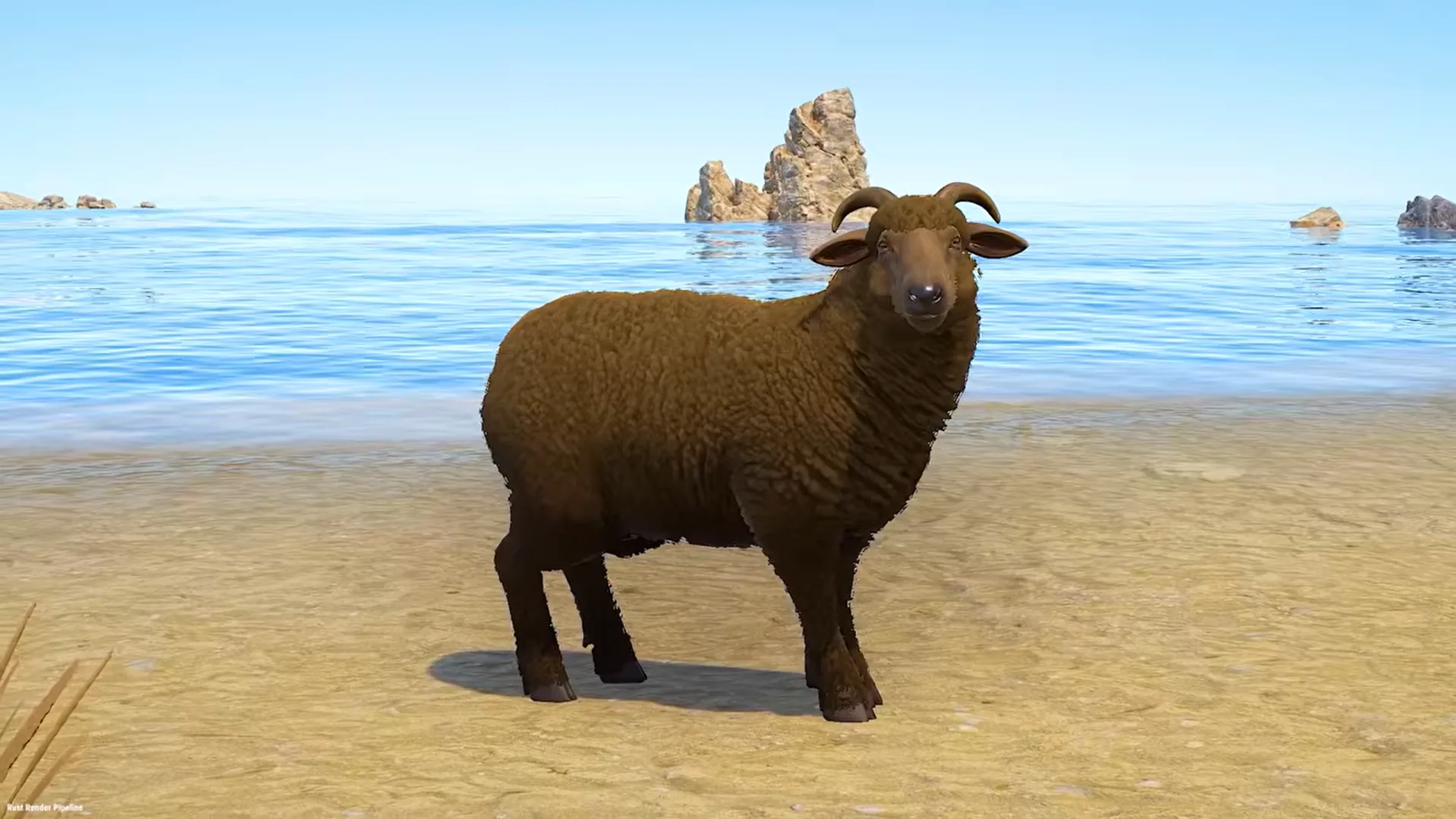
Keeping sheep is a great way to generate useful resources that you can later trade at the Ranch. While alive, these animals can provide you with:
- Dung: Can be used as an efficient fuel source.
- Wool: You can shear a sheep to get wool.
If you decide to kill a sheep, you'll get 12x raw mutton, 10x cloth, 50x bone fragments, 20x leather, and 20x animal fat. You'll also receive any extra wool the sheep is carrying when you kill it.
How Wool Works
You can shear a sheep for wool after a certain cooldown that depends on each animal’s genetics. Also, when harvesting the wool with a knife, you should watch your swings to avoid damaging the sheep by hitting a section you’ve already sheared.
You can process wool in a Recycler to obtain 3x cloth. The Red Recycler has a 75% chance of producing a fourth piece of cloth, while the Green Recycler has a 50% chance.
How to Sell Livestock at the Stables
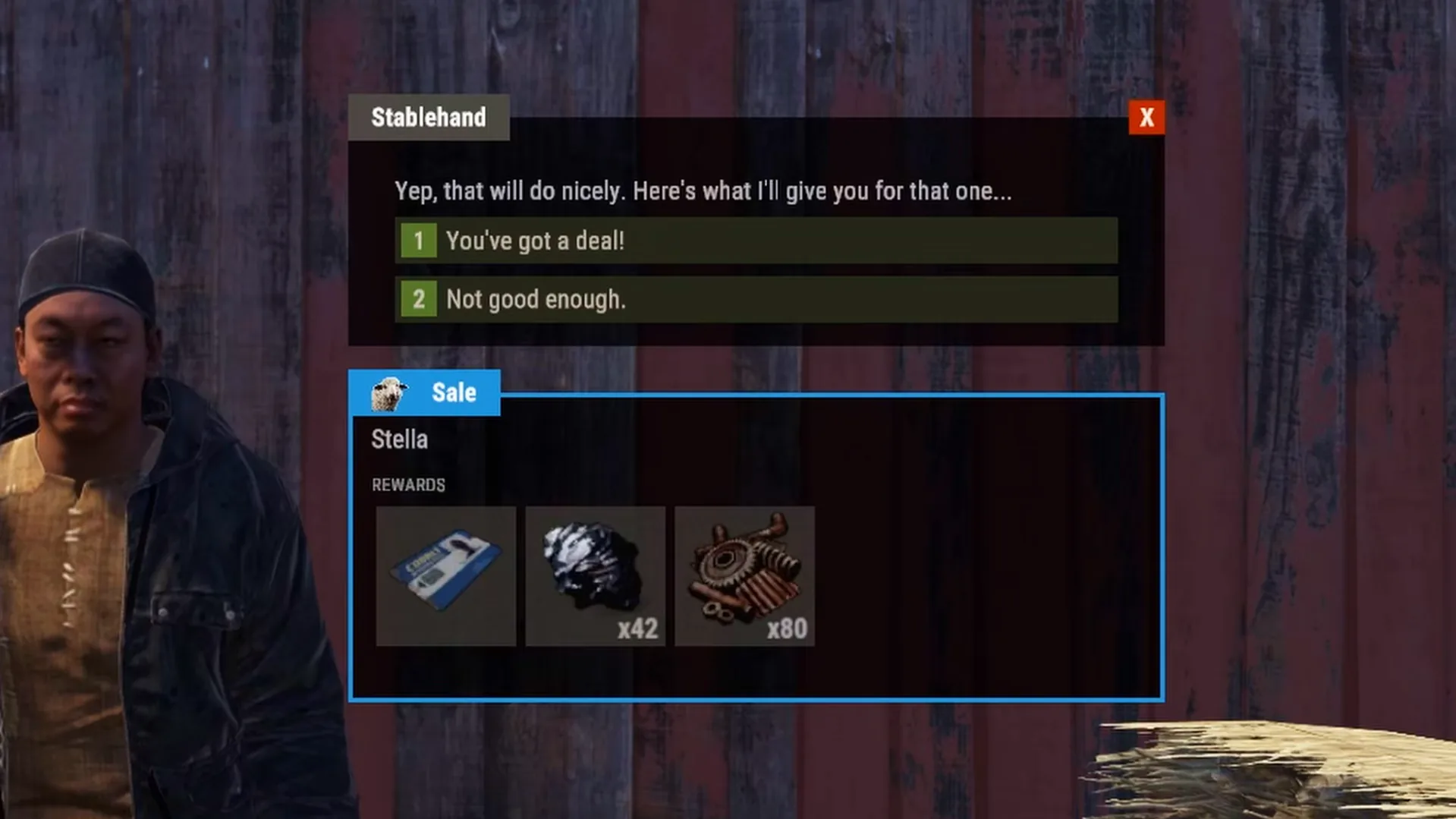
Livestock provide different resources, and you can also trade your animals at the stables. Here are four simple steps to follow when selling sheep and cows:
- Ensure that your cattle or sheep are fully grown and in good condition.
- Lead your animals to the stables at the Ranch or Large Barn.
- Talk to the Livestock Vendor, usually located outside the stables.
- The vendor will make a random offer based on the animal's genetic quality. You can receive up to three offers and decide whether to accept or decline each one.
Please note that if you decline all three offers, the vendor will refuse to buy your animal. In this case, you need to wait for 15 minutes before trying to trade it again.
How to Sell Wool
Players can also take wool stacks (up to 1,000 at a time) to the Livestock Vendor at any Ranch or Large Barn. The NPC will make a random offer based on the amount of wool you bring. You can decline the offer up to three times in the hope of receiving a better deal. Refusing an offer too many times will lock you out for 15 minutes.
Rust Biofuel Generator: Practical Usage
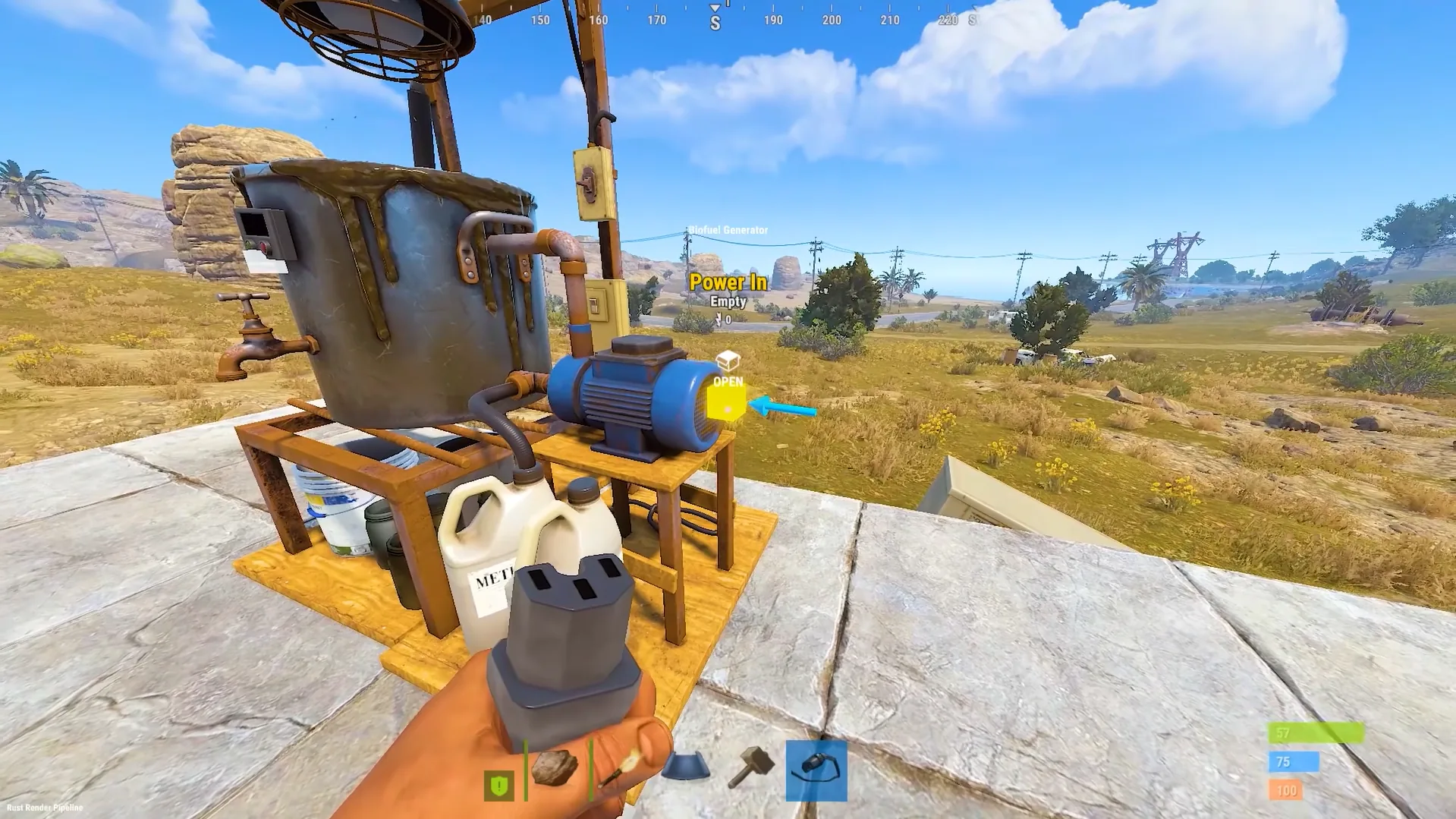
The Biofuel Generator is a Tier 1 deployable device that you can use to convert organic items such as dung, worms, or spoiled food into Low Grade Fuel. You'll need a Level 1 Workbench and the corresponding blueprint, which you can unlock through the Tech Tree. Plus, you’ll need to collect materials: 250x Metal Fragments and 150x Wood.
Once crafted, place the Biofuel Generator on a foundation inside your base and supply it with 5 units of power. You can put food or dung into the input slots. Processing speed and the amount of Low Grade Fuel produced depend directly on the item type and its calorie content.
The Biofuel Generator also requires manual stirring to keep the processing cycle running. You can do it by holding the “E” key by default. Typically, you need to stir the generator again after every 60 units of fuel processed, although this interval may change depending on how much food you add. The machine is designed with indicator lights that show its current status: processing, finished, empty, or waiting to be stirred.
Best Uses for a Livestock Farm in Rust
So, is maintaining a livestock farm in Rust really worth your time and resources? If you still have doubts, here are the best use cases for cows and sheep in the game:
- Milk production and tea boosting (cows only)
- Wool production (sheep only)
- Meat and material production.
- Dung production for Biofuel Generator
- Vendor bartering
Just like other animals in the game, livestock can impact your Rust server performance, especially if you run a highly populated server or one with long wipe cycles. However, Rust servers have a hardcoded limit on the amount of frame time allocated to AI processing. This limit prevents animal overpopulation from consuming an unlimited amount of server frame time.
Exceeding the AI frame-time budget doesn't necessarily cause a major FPS drop. Instead, animals may move less smoothly and react more slowly. Also, the update introduces a multithreaded navigation system (Navmesh). It’s at least twice as fast as previous iterations, significantly reducing the base CPU cost per animal.
Other Additions in the Livestock Update
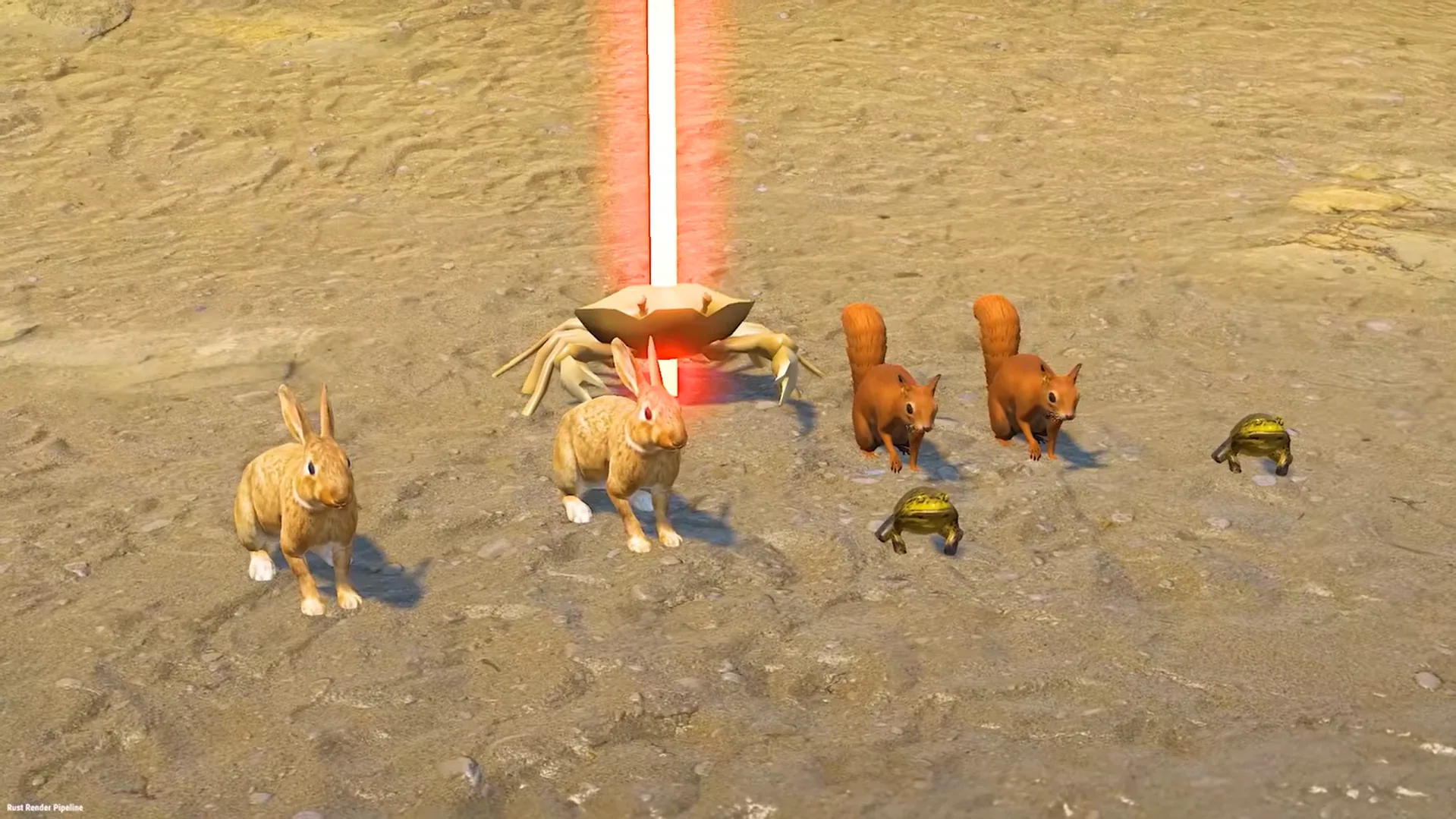
The October 2026 Rust update has significantly changed the game and introduced many new features. Some of these additions aren't related to livestock and affect other aspects of the game:
- 13 monuments now feature locked loot rooms, which you can open only by inserting enough Heavy Fuses into the Power Plant.
- The Air Wolf helipad at Bandit Camp starts each wipe broken, requiring the server to work together to repair it before the vendor sells air vehicles again.
- Added sandbag barricades with four stack stages.
- Added squirrels, rabbits, frogs, jellyfish, sea turtles, and crabs around the map.
- Introduced new food, such as Shepherd’s Pie and mutton.
- The update also includes technical and quality-of-life improvements, such as client-side prediction for explosives and reduced memory usage.
- Added 11 new achievements.
Common Livestock Mistakes in Rust
Rust is a survival game where each mistake may cost you all your progress. Although a livestock farm provides you with a steady supply of food and useful materials, some “deadly sins” may lead to dead animals and wasted resources:
- Building animal pens outside your main base walls makes your livestock an easy target for enemy players and leaves your resources vulnerable to theft.
- Cramming too many animals into a small space can prevent them from reaching food, eventually causing them to starve.
- Breeding animals without filtering out bad genes results in low resource production and livestock value.
- Killing livestock before they reach adulthood yields significantly fewer resources, so wait until they are fully grown before harvesting them.







 en | USD

 CHAT WITH GODLIKE TEAM