Expert Summary
An 8GB Minecraft server plan does not tell the whole performance story. Two hosts can offer the same RAM class and still behave very differently once players begin exploring, generating chunks, and putting real pressure on the server thread.

Make your own FREE minecraft server
MINECRAFT FREE SERVER
In this benchmark, Godlike and Apex Hosting were tested on comparable 8GB Minecraft server plans using Minecraft 1.21.1, Java 21, NeoForge, Spark, Chunky, and a 4-bot exploration load. Godlike completed the 16,129-chunk Chunky test in 2:43, while Apex took 12:16 for the same workload. Under the 4-bot load test, Godlike also held a much stronger short-window TPS average: 16.28 TPS compared with Apex’s 7.03 TPS.
The important point is not only that Godlike performed better in this benchmark run. The useful takeaway is that RAM and a recognizable CPU name are not enough by themselves. Apex also ran on Ryzen 9950X3D powerful hardware in this dataset, but Godlike still finished the chunk-generation test about 4.5x faster and held about 2.3x higher short-window TPS under active exploration pressure.
Why This Benchmark Matters
Minecraft server lag usually shows up when the world starts doing real work. A server can look fine at spawn, then struggle when several players run in different directions, generate new chunks, trigger mobs, build farms, or start using plugins and mods.
For players, that feels like delayed block breaking, rubber-banding, slow mob reactions, uneven movement, and commands taking longer than they should. For server owners, it means the 8GB plan that looked fine on a pricing page may not feel fine once the world becomes active.
This comparison tests a practical question:
If both hosts offer an 8GB Minecraft plan, which one handles chunk generation and exploration pressure better in this benchmark run?
Test Methodology
Methodology note: world seeds were not standardized between hosts, so this benchmark should be read as a practical hosting workload comparison rather than a perfect laboratory simulation. The controlled points were the 8GB plan class, Minecraft 1.21.1, Java 21, NeoForge, the same 4-bot movement pattern, and the same Chunky workload of 16,129 processed chunks.
The test was designed around real Minecraft server pressure, not a synthetic score detached from gameplay.
Both providers were tested on 8GB-class Minecraft server plans. At the time of testing, the recorded first-month discounted prices were:
- Godlike: $22.39
- Apex Hosting: $20.99
The test setup used:
- Minecraft version: 1.21.1
- Java version: 21
- Server platform: NeoForge
- Monitoring/profiling: Spark
- Chunk pre-generation: Chunky
- Load test: 4 bots moving away from spawn
- Bot speed: 4 blocks per second
- Bot start point: spawn area, around Y=150
- Test duration: 5 minutes
- Mobs: enabled
- Extra test mods/tools: Spark, Chunky, and a custom bot mod
The 4-bot test simulates a common server pain point: players leaving spawn and generating new terrain in different directions. That kind of movement creates chunk-generation pressure while the server still has to tick mobs, process world activity, and keep players responsive.
For the Chunky benchmark, both servers processed the same amount of world generation work:
Processed chunks: 16,129
Methodology note: this was a controlled benchmark run, not a long-term statistical study. The goal was to compare how each 8GB server behaved under the same practical stress pattern.
Hardware Tested
| Provider |
Plan class |
Plan RAM |
CPU shown in Spark |
Java |
Minecraft |
| Godlike |
8GB Minecraft plan |
8GB |
AMD Ryzen 9 9950X3D |
Java 21 |
1.21.1 |
| Apex Hosting |
8GB Minecraft plan |
8GB |
AMD Ryzen 9 7950X |
Java 21 |
1.21.1 |
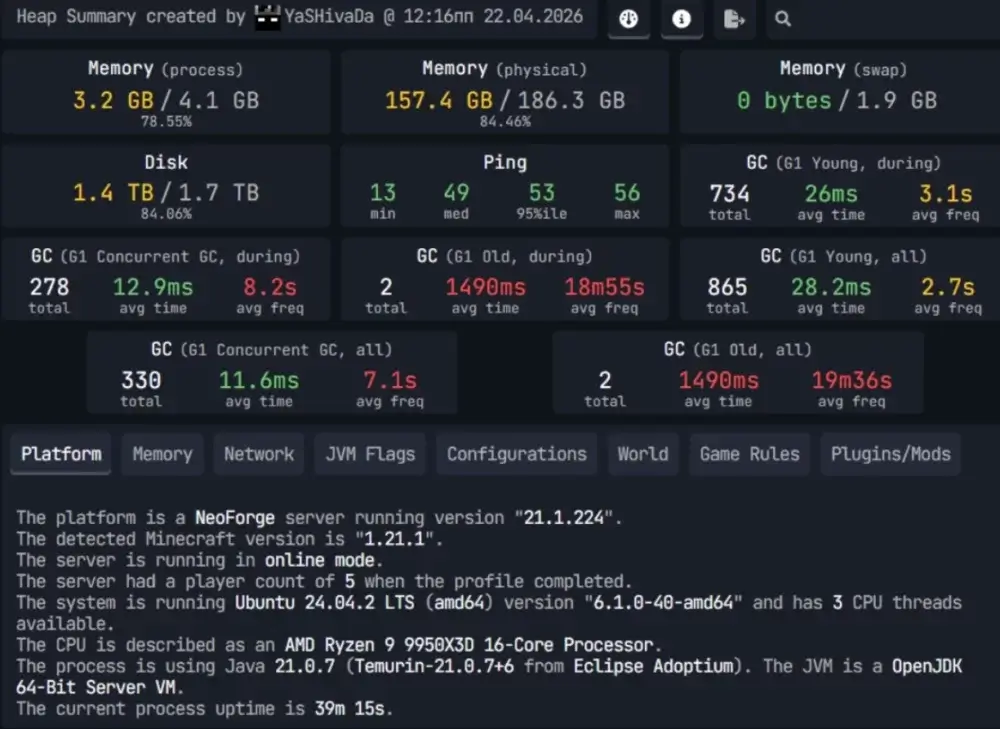
Godlike benchmark hardware
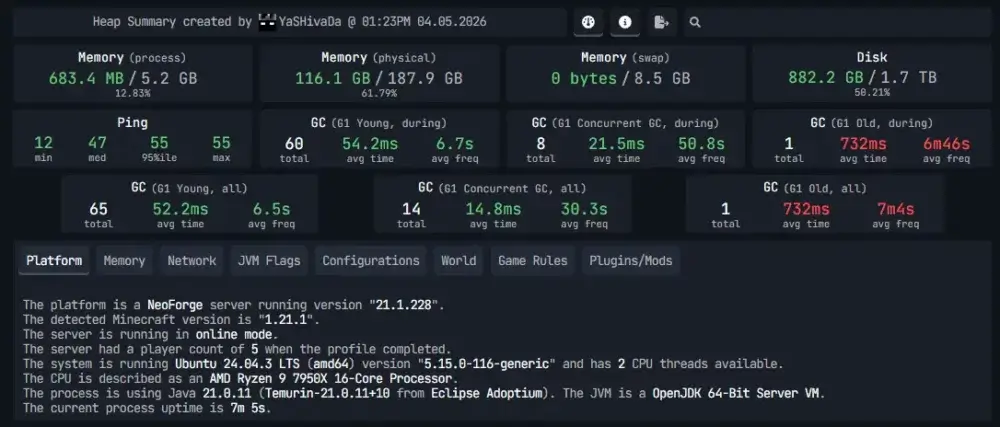
Apex benchmark hardware
This is an important comparison because both servers were on Ryzen hardware. The result is not simply “Ryzen beats non-Ryzen.” In this test, Godlike’s Ryzen 9 9950X3D-based 8GB server delivered much stronger Minecraft workload results than the tested Apex Ryzen 9 7950X-based 8GB server.
That suggests the full hosting environment matters: CPU generation and cache, allocation, server tuning, storage, and how the plan behaves under actual world-generation pressure.
Benchmark 1: TPS Under 4-Bot Exploration Load
TPS means ticks per second. A healthy Minecraft server aims for 20 TPS. When TPS drops, gameplay becomes delayed: blocks break late, mobs react slowly, movement feels uneven, and exploration starts to drag.
The 4-bot test was designed to stress live chunk generation. Four bots moved away from spawn in different directions, forcing the server to generate and tick new areas during the run.
TPS Results
| Provider |
TPS 5s |
TPS 10s |
TPS 1m |
Short-window average |
| Godlike |
14.33 |
18.64 |
15.87 |
16.28 |
| Apex Hosting |
6.10 |
8.65 |
6.33 |
7.03 |
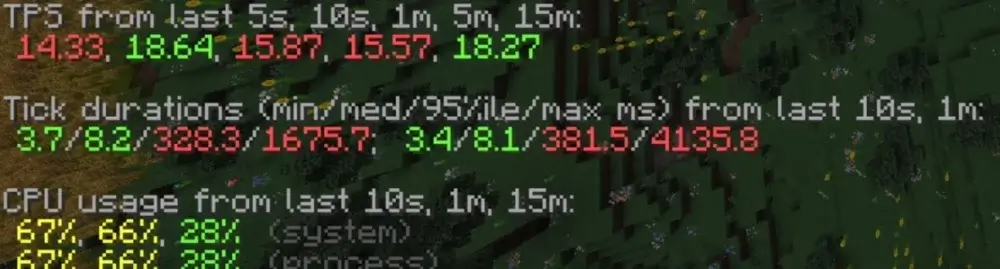
Godlike TPS result
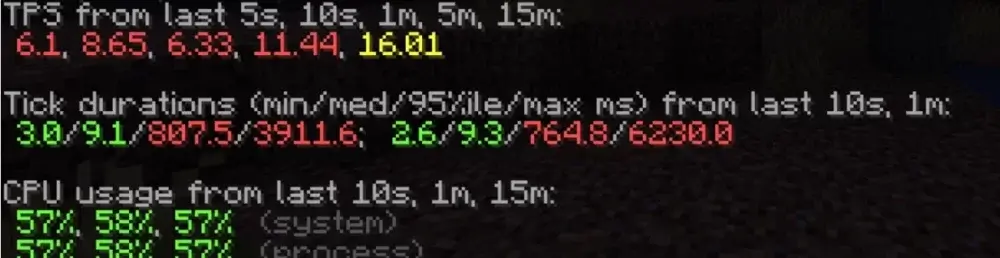
Apex hosting TPS result
Short-window average is calculated from the visible 5s, 10s, and 1m TPS values during the active load period. These windows matter because they show what happens when exploration pressure is actually hitting the server, instead of smoothing the result over a longer period.
In this run, Godlike held about 2.3x higher short-window TPS than Apex Hosting.
What That Means in Gameplay
Apex’s 1-minute TPS was 6.33, which is far below the normal 20 TPS target. In real play, that kind of drop can feel heavy: blocks respond late, mobs and combat feel delayed, and exploration becomes uneven when the server is trying to keep up.
Godlike’s 1-minute TPS was 15.87 under the same test pattern. That is still below a perfect 20 TPS, but it leaves much more room for the server to stay responsive while chunks are being generated.
The difference matters most in the exact situations where Minecraft servers usually struggle: several players leave spawn, generate terrain, trigger mobs, and expand the active world at the same time.
Benchmark 2: Chunky 16,129-Chunk Render Time
Chunky is commonly used to pre-generate Minecraft worlds. Pre-generation helps reduce live exploration lag because chunks are created before players reach them.
For this benchmark, both servers processed 16,129 chunks.
Chunky Results
| Provider |
Chunks processed |
Completion time |
Approx. chunks/sec |
| Godlike |
16,129 |
2:43 |
98.95 |
| Apex Hosting |
16,129 |
12:16 |
21.91 |
Godlike completed the same Chunky workload about 4.5x faster than Apex Hosting.
Another way to read it: Apex needed 9 minutes and 33 seconds longer to finish the same 16,129-chunk generation job.
Why Chunky Speed Matters
Chunky render time is not just a benchmark number. It affects how long a server owner waits before a world is ready, how painful resets and pregeneration feel, and how much chunk work may spill into live gameplay if the world is not prepared.
If a server is slow during controlled chunk pre-generation, that is a warning sign for live exploration too. When players generate chunks naturally, the server has to create terrain while also handling mobs, players, commands, plugins, and world activity.
That is why the Chunky test and the 4-bot TPS test work well together. Chunky shows raw world-generation throughput. The bot test shows how the server behaves when chunk pressure happens during gameplay.
Same 8GB RAM, Very Different Results
The most useful lesson from this benchmark is that 8GB RAM is not a complete performance metric.
RAM gives the server room to operate, but Minecraft also needs strong per-core CPU performance, fast storage, stable resource allocation, and good behavior under world-generation pressure. A server can have enough memory and still struggle if the rest of the environment cannot keep up.
This Apex comparison is especially useful because it shows that even a strong CPU name does not guarantee the same result across hosts. Apex’s tested server used a Ryzen 9 7950X, but Godlike still delivered much faster Chunky completion and much stronger TPS under the 4-bot load.
For a server owner, that difference matters in practical situations:
- several players exploring at once;
- SMP worlds with mobs, farms, and redstone;
- modded servers with heavier world generation;
- public servers where players leave spawn in different directions;
- pre-generating a world before launch;
- keeping TPS stable as the world grows.
Price Context
At the time of testing, the recorded first-month discounted prices were:
| Provider |
Tested plan class |
Recorded first-month discounted price |
| Godlike |
8GB Minecraft server |
$22.39 |
| Apex Hosting |
8GB Minecraft server |
$20.99 |
Apex was slightly cheaper in this recorded first-month price comparison. The performance gap, however, was large enough that the decision is not just about the smaller number on the checkout page.
In this benchmark run, Godlike cost slightly more for the first month but delivered about 2.3x higher short-window TPS and about 4.5x faster Chunky completion.
Results Summary
| Metric |
Godlike |
Apex Hosting |
Result |
| CPU shown in Spark |
Ryzen 9 9950X3D |
Ryzen 9 7950X |
Both Ryzen; Godlike still performed better in this test |
| 1m TPS under 4-bot load |
15.87 |
6.33 |
Godlike held about 2.5x higher 1m TPS |
| Short-window TPS average |
16.28 |
7.03 |
Godlike held about 2.3x higher short-window TPS |
| Chunky processed chunks |
16,129 |
16,129 |
Equal workload |
| Chunky completion time |
2:43 |
12:16 |
Godlike finished about 4.5x faster |
| Approx. chunks/sec |
98.95 |
21.91 |
Godlike processed chunks much faster |
| Recorded first-month discounted price |
$22.39 |
$20.99 |
Apex was slightly cheaper in this recorded price snapshot |
Should You Move an 8GB Minecraft Server to Better Hardware?
If your current 8GB Minecraft server still drops TPS when players explore, the problem may not be memory. It may be the hardware and hosting environment behind the plan.
This benchmark is a good example. Both tested servers were in the 8GB class, and both used Ryzen CPUs. Even so, the results were not close under chunk-generation pressure.
For server owners, the practical question is not only “How much RAM do I get?” It is also:
- What CPU is behind the plan?
- How does the server behave when players generate chunks?
- Can it hold TPS under exploration pressure?
- How long does pre-generation take?
- Can the plan scale if the world grows?
If you are paying for an 8GB Minecraft server, make sure you are buying more than memory on a pricing table. You are buying the real gameplay experience that hardware delivers under load.
Conclusion
In this benchmark, Godlike outperformed Apex Hosting in both major tests. It held stronger TPS during the 4-bot exploration load and completed the Chunky 16,129-chunk render test about 4.5x faster.
The bigger lesson is that an 8GB Minecraft plan is only part of the story. Apex was slightly cheaper in the recorded first-month price snapshot and also used Ryzen hardware, but Godlike delivered much stronger results under the tested Minecraft workload.
For server owners who care about TPS stability, faster world generation, and smoother exploration, the hardware behind the plan matters. RAM is important, but the real test is how the server behaves when players start loading the world.








 en | USD
 CHAT WITH GODLIKE TEAM